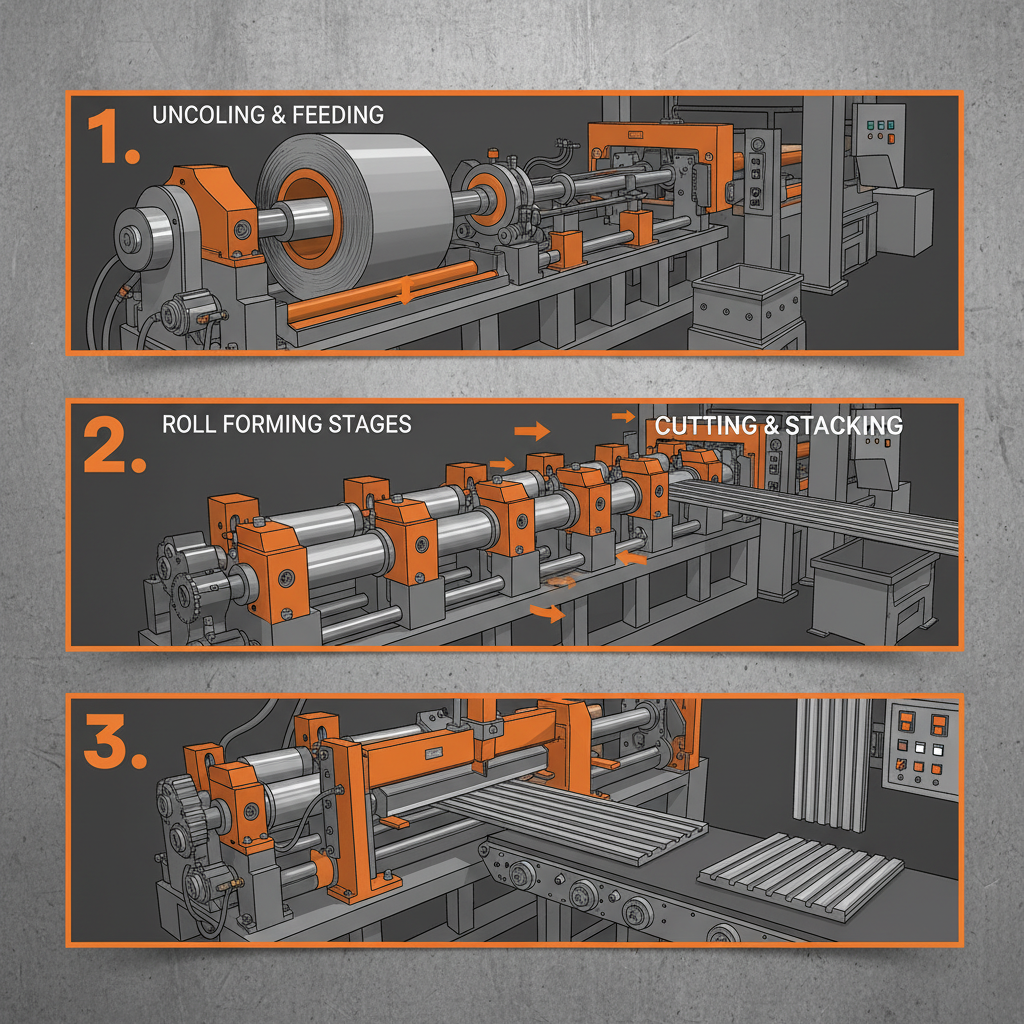
Look, I've been running around construction sites for over a decade, and honestly, the biggest change I’ve seen lately is everyone chasing automation. Roll forming is getting smarter, faster, but it also feels… rushed sometimes. Everyone wants the latest tech, the fastest setup, but forgets the basics. You know, like making sure the steel actually feels right in your hands.
I’ve seen so many designs that look amazing on paper, but completely fall apart when you try to actually build them. People get caught up in tolerances and fancy features, and forget that this stuff is going to be bolted together by guys who are dealing with rain, dust, and a deadline. Simple is almost always better. Almost.
And don’t even get me started on materials. We’re using a lot more high-strength steel these days, which is good, but it’s also… different. It smells different, it cuts different, it requires different welding techniques. I encountered this at a factory in Tianjin last time; they were using a new alloy, and the welders were struggling to get a clean bead. Took us a week to figure out the right settings. It’s not just about the specs on the datasheet, it’s about how it behaves in the real world.
The Changing Landscape of Roll Forming Machine Supply
The roll forming machine supplier market is… hectic. It used to be you had a few big players, and that was it. Now? Everyone’s building them. Mostly in China, honestly. This means lower prices, which is good, but also a lot more variation in quality. You’ve got to know who you're buying from. And I’ve noticed a real trend towards machines that can handle more complex profiles. Everyone wants curved steel, embossed patterns, you name it.
It’s pushing suppliers to innovate, which is great, but it also means they're packing more and more features into these machines. Sometimes I think they’re trying to solve problems that don’t actually exist. Strangely, I have had fewer issues with suppliers providing simpler roll forming machine suppliers – they are what they are, and it's a lot easier to troubleshoot when something goes wrong.
Design Pitfalls: Avoiding the Paper-to-Reality Gap
To be honest, the biggest mistake I see is over-engineering. Engineers love to add features, but they don’t always think about how those features will impact the manufacturing process. I had one design last year with a ridiculously complex bend radius. Looked beautiful in the CAD model, but it took us three times as long to set up the machine, and the scrap rate was through the roof.
Another thing: accessibility. Can you easily get to all the adjustment points? Can you quickly change the tooling? These are things that matter on the shop floor. You can't be spending half an hour trying to tighten a bolt in a hard-to-reach place. Also, the material thickness! So many designs assume a perfect, consistent material thickness. In the real world, you get variations. It's just how it is.
And don’t forget about lubrication. A well-lubricated machine is a happy machine. Make sure there are easily accessible lubrication points, and that the lubrication system is robust enough to handle the demands of continuous operation.
Material Matters: Beyond the Datasheet
I’ve said it before, and I’ll say it again: you can’t just rely on the datasheet. You need to feel the material. Does it have the right amount of flexibility? Is it free of defects? Does it smell… right? (Yes, seriously, a bad smell can be a sign of contamination). We're seeing more demand for pre-painted steel, which is great, but the paint quality varies wildly.
I remember one shipment of steel from a new supplier… the paint smelled like burnt plastic. Turns out they were using a cheap, off-gas paint that was causing all sorts of problems. We had to reject the entire shipment. The feel is also important; if it's too slick, it'll slip during forming. If it's too rough, it'll wear out the tooling faster. It’s a Goldilocks situation.
And don't underestimate the importance of storage. Steel needs to be protected from the elements. Rust is the enemy, plain and simple. Keep it dry, keep it clean, and keep it covered. Simple stuff, but it makes a big difference.
Real-World Testing: Beyond the Lab
Lab tests are fine, but they don’t tell the whole story. You need to test these machines in a real-world environment. I’m talking about putting them on a dusty construction site, running them for 12 hours straight, and seeing how they hold up. I saw a company once that ran a 1000-hour run on a roll forming machine supplier just to see if it would break.
Pay attention to the tooling wear. How quickly are the rollers wearing down? Are they showing signs of cracking or deformation? Check the alignment regularly. Even a small misalignment can cause significant problems down the line. Anyway, I think testing should also include thermal stress - leave it in the sun, expose it to cold, it really separates the wheat from the chaff.
Roll Forming Machine Supplier Reliability Testing Metrics
User Behavior: What They Actually Do
This is where things get interesting. You design a machine to be operated in a certain way, but the guys on the shop floor will always find a way to do things differently. They’ll shortcut steps, they’ll ignore warnings, they’ll… improvise. You've got to design for that.
I’ve seen guys use a wrench as a shim, a hammer as an adjustment tool, and a roll of duct tape as a… well, let’s just say a temporary fix. You can’t account for everything, but you can make the machine as idiot-proof as possible. And for goodness’ sake, make the controls intuitive!
Advantages and Disadvantages: The Honest Truth
Look, roll forming is a fantastic process. It’s fast, efficient, and it can produce complex profiles with minimal waste. But it’s not perfect. The initial setup cost can be high, especially for custom profiles. And you’re limited by the geometry of the tooling. Changing profiles can be time-consuming and expensive.
But if you're running a high-volume production, it's almost always the most cost-effective solution. And the quality is generally very good. As long as you maintain the tooling properly. Don’t skimp on the tooling. It's the heart of the machine, and if it fails, everything stops.
Customization & A Customer Story
Customization is where things get really interesting. Most suppliers will work with you to design a custom roll forming line to meet your specific needs. Last month, that small boss in Shenzhen who makes smart home devices insisted on changing the interface to , and the result was a week of frustration. He claimed it was for "future-proofing," but it just created compatibility issues with all his existing equipment.
But generally, customization is a good thing. You can tailor the machine to your specific material, profile, and production volume. It’s about finding the right balance between cost and functionality. And it is about the supplier listening to your needs.
I once worked with a supplier who refused to make any changes to their standard design. It was a disaster. The machine didn’t fit in the customer’s factory, and it couldn’t handle the material they were using. It just sat there, a very expensive paperweight.
Table summarizing Key Considerations for Roll Forming Machine Selection
| Profile Complexity |
Production Volume |
Material Compatibility |
Supplier Support |
| Simple (e.g., C-channels) |
Low (under 10,000 ft/month) |
Limited to common steel grades |
Basic installation and training |
| Moderate (e.g., hat sections) |
Medium (10,000 – 50,000 ft/month) |
Wide range of steel, aluminum, and other materials |
On-site maintenance and troubleshooting |
| Complex (e.g., custom profiles) |
High (over 50,000 ft/month) |
Exotic alloys and pre-painted materials |
Remote diagnostics and preventative maintenance |
| High-Precision |
Variable |
Tight tolerances and material certification |
Dedicated engineer support and tooling design |
| Automated Feed System |
Large Batch Sizes |
Consistent Material Quality Required |
Training for Automated System Operation |
| Adjustable Roll Form Stations |
Frequent Profile Changes |
Multiple Material Types |
Experienced Technicians for Quick Changeovers |
FAQS
Lead times vary wildly, but generally, you're looking at 12-20 weeks for a completely custom design. It depends on the complexity of the profile, the availability of materials, and the supplier's workload. Factor in another few weeks for tooling fabrication. Don’t expect it overnight, and always get a detailed timeline upfront. It’s a long process, and clear communication is key.
Roll forming machines require regular maintenance to keep them running smoothly. This includes lubrication, tooling inspection and replacement, and alignment checks. A good preventative maintenance schedule is crucial. Expect to spend at least a few hours a week on maintenance, and schedule more extensive downtime for annual inspections. Neglect it, and you'll pay for it later.
Tooling lifespan depends on several factors, including the material being formed, the complexity of the profile, and the quality of the tooling itself. Generally, you can expect good tooling to last for 50,000 to 200,000 linear feet of production. Keep a close eye on the tooling for signs of wear, and replace it as needed.
Safety is paramount. Look for features like emergency stop buttons, safety guards, and light curtains. The machine should be properly grounded, and all electrical components should be enclosed. Operators should be properly trained on the safe operation of the machine, and should always wear appropriate personal protective equipment (PPE).
For high-volume production, roll forming is generally more cost-effective than other metal forming processes like stamping or extrusion. The initial investment in tooling can be significant, but the cost per part is typically much lower. However, if you only need a small number of parts, other processes might be more economical. It really depends on your specific needs.
Yes, absolutely. Many older roll forming machines can be retrofitted with automation, such as automatic coil feeding, stacking, and cutting systems. This can significantly increase production efficiency and reduce labor costs. However, it's important to carefully assess the condition of the machine and the feasibility of the retrofit before proceeding.
Conclusion
Ultimately, roll forming is a powerful process, but it's not a magic bullet. It requires careful planning, a good understanding of the materials, and a reliable supplier. It's about balancing cost, quality, and efficiency. You need to consider the entire process, from material selection to tooling design to machine operation.
And remember, whether this thing works or not, the worker will know the moment he tightens the screw. That’s what matters in the end. If it’s easy to use, reliable, and produces a good part, then it’s a good machine. If it’s a headache, then it doesn’t matter how fancy it is. For more information, visit our website at www.yowinmachine.com.