
Purlin Roll Forming Machine Manufacturer - Top Quality & Efficiency
Introduction to Advanced Purlin Roll Forming Technology
In the modern construction and industrial sectors, the demand for lightweight, high-strength, and cost-effective structural components is ever-increasing. Purlins, essential structural elements used to support roof and wall cladding, play a critical role in this ecosystem. The efficiency and precision of their production are paramount, directly impacting project timelines and structural integrity. This is where a specialized purlin roll forming machine manufacturer becomes indispensable, offering sophisticated solutions for producing C, Z, U, and customized purlin profiles. These machines are engineered to transform flat sheet metal coils into precisely shaped purlins through a continuous cold-forming process, ensuring dimensional accuracy and material efficiency.
The focus of this comprehensive overview is to delve into the intricate world of purlin roll forming machines, covering everything from their operational principles and technical specifications to their broad range of applications and the critical factors in selecting a reliable supplier. We will explore the latest industry trends, highlight technical advantages, provide detailed process flows, and present concrete data visualizations to underpin the expertise, authoritativeness, and trustworthiness of leading manufacturers in this domain.
Current Industry Trends in Purlin Roll Forming
The purlin roll forming industry is constantly evolving, driven by advancements in materials science, automation, and a global push towards sustainable and efficient construction practices. Key trends observed among leading purlin roll forming machine manufacturers include:
- Increased Automation and Smart Manufacturing: Integration of advanced PLC control systems, HMI interfaces, and IoT capabilities allows for remote monitoring, predictive maintenance, and seamless data exchange, optimizing production efficiency and reducing manual intervention.
- Enhanced Flexibility and Profile Customization: Manufacturers are developing machines capable of rapid changeovers between C, Z, U, and customized profiles, often with automatic web and flange adjustment, significantly reducing downtime and expanding product versatility.
- Focus on Energy Efficiency: Modern purlin roll forming machine manufacturer designs incorporate energy-saving servo motors and optimized hydraulic systems, leading to lower operational costs and reduced environmental impact.
- Higher Speed and Precision: Continuous innovation in roller design and material handling ensures faster production speeds while maintaining exceptionally tight tolerances, crucial for high-volume projects.
- Sustainability and Material Optimization: Demand for machines that can efficiently process various high-strength steel grades and thin-gauge materials, minimizing scrap and maximizing material utility, is growing.
These trends reflect a mature industry striving for greater operational excellence, adaptability, and environmental responsibility, setting new benchmarks for efficiency and product quality.
The Purlin Roll Forming Process Flow
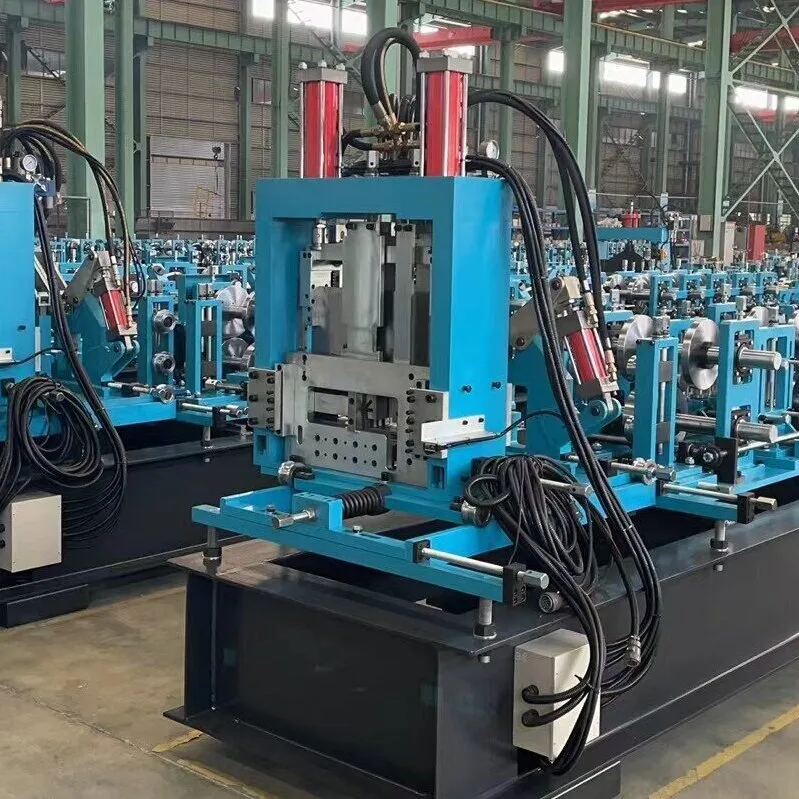
The manufacturing of purlins by a state-of-the-art purlin roll forming machine manufacturer involves a highly precise and automated process, transforming flat steel coils into structurally sound profiles. Below is a detailed breakdown of the typical process flow:
1. Raw Material Handling & Decoiling
- Material: High-grade galvanized steel (e.g., Q235, Q345, S235JR, S355JR), pre-painted steel, or cold-rolled steel, typically in coil form with thicknesses ranging from 1.5mm to 3.0mm. These materials are chosen for their excellent strength-to-weight ratio and corrosion resistance.
- Process: Steel coils are loaded onto a hydraulic or manual decoiler. The decoiler unwinds the coil, feeding the strip into the machine. Tension control mechanisms ensure smooth and consistent material delivery.
2. Leveling & Guiding
- Process: The steel strip passes through a leveling device to remove any coil set or inherent curvature, ensuring a perfectly flat base for subsequent forming. Side guides maintain precise lateral alignment, crucial for dimensional accuracy.
3. Pre-Punching & Pre-Cutting (Optional)
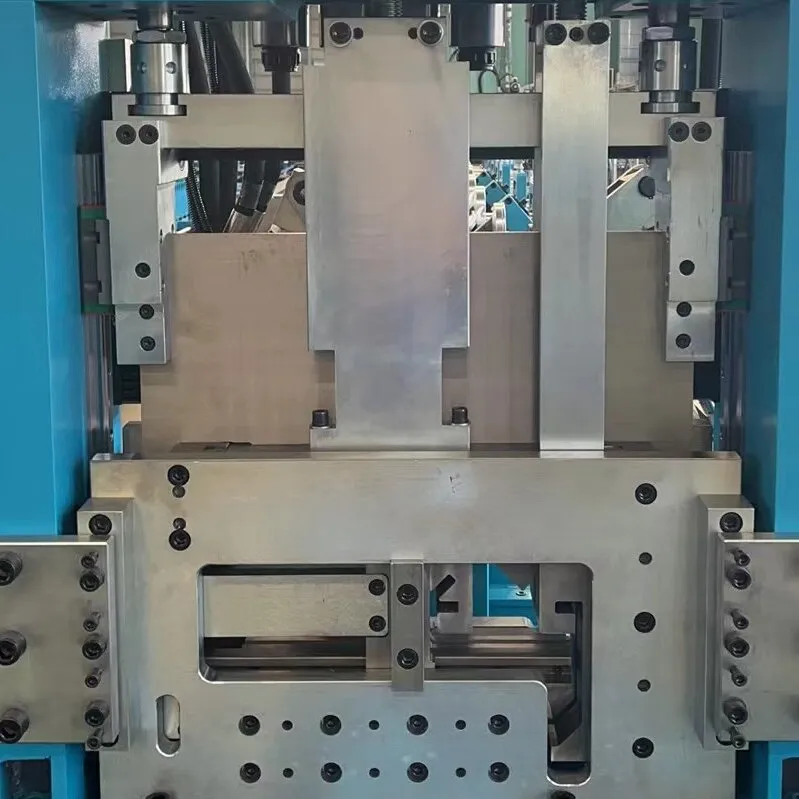
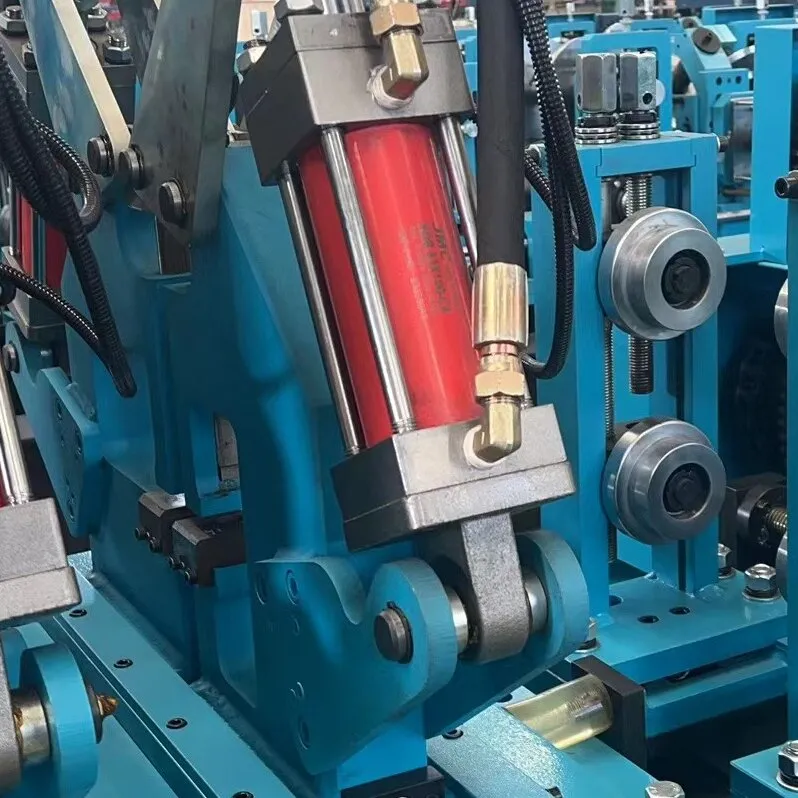
- Process: Depending on the purlin design, holes for fasteners or service penetrations are punched, and sometimes the strip is pre-cut to specific lengths before the main roll forming. This is typically done with hydraulic punching units synchronized with the line speed.
4. Roll Forming
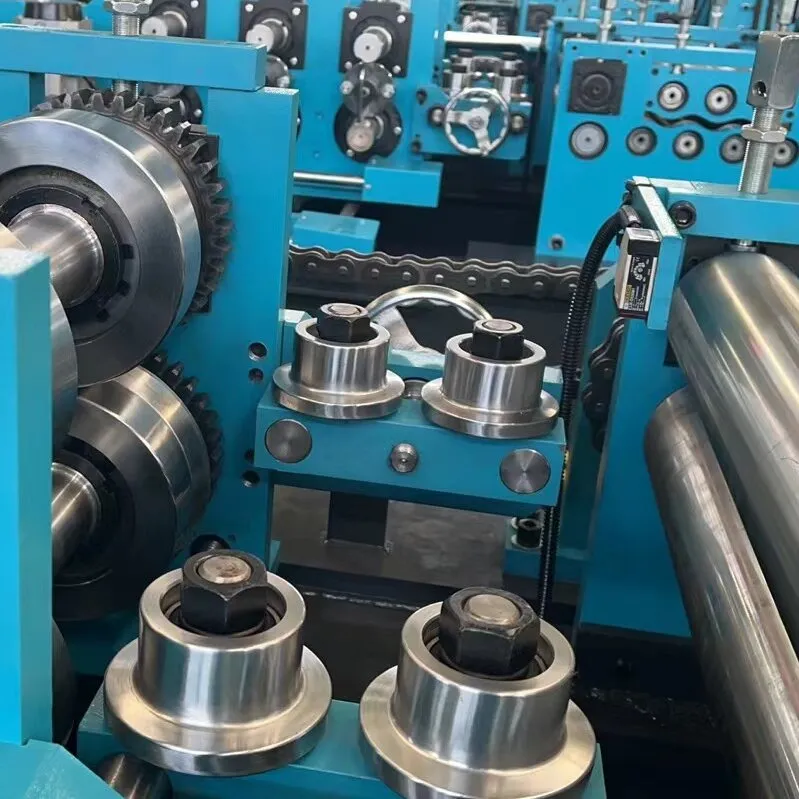
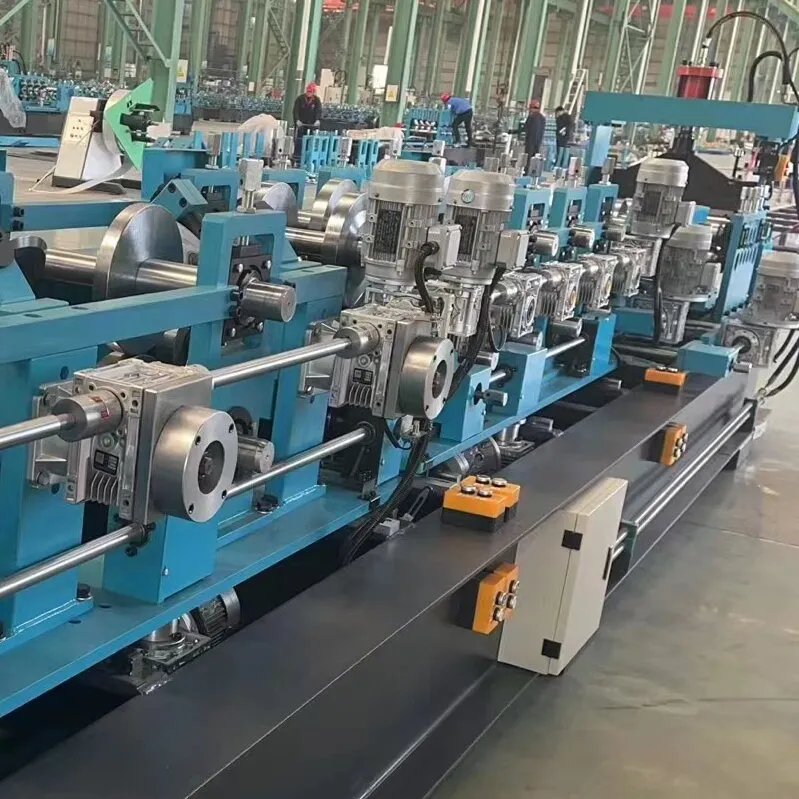
- Process: This is the core of the operation. The leveled strip moves through a series of precisely designed roller dies (roll stands). Each pair of rollers progressively bends the metal into the desired profile (C, Z, or U-shape) in incremental stages. The number of roll stands varies (typically 12-18) depending on the complexity of the profile and material thickness. Rollers are often manufactured from high-grade tool steel (e.g., Cr12, GCr15), heat-treated to HRC58-62 for durability and wear resistance.
5. Post-Cutting
- Process: Once the purlin reaches the programmed length and desired profile, a hydraulic flying shear or saw cutter precisely severs the formed section. The "flying" nature ensures continuous production without stopping the roll former.
6. Output & Stacking
- Process: Finished purlins are conveyed to an automatic or manual stacking system, ready for packaging and shipment.
Quality Control & Testing Standards
Throughout this process, rigorous quality control measures are implemented. Products are checked for dimensional accuracy against specifications (e.g., EN 10162, ASTM A653), material properties are verified, and surface finish is inspected. Reputable manufacturers adhere to international standards like ISO 9001 for quality management systems and ANSI/AWS standards for any welded components. The designed service life for well-maintained purlin roll forming machines can exceed 15-20 years, provided regular maintenance and use of high-quality components.
Technical Specifications of Advanced Purlin Roll Forming Machines
Modern purlin rolling machines are engineered for robustness, precision, and high performance. The technical specifications listed below represent the capabilities of a high-quality CZ purlin roll forming machine, such as the "Quotation For Cz Purlin Roll Forming Machine From Yowin" model, demonstrating expertise in mechanical and control engineering.
| Parameter | Specification |
|---|---|
| Material Thickness Range | 1.5mm - 3.0mm (typically Galvanized Steel, Q235, Q345) |
| Forming Speed | 15-25 m/min (adjustable, excluding punching/cutting time) |
| Purlin Web Height | 80mm - 300mm (automatic adjustment) |
| Flange Width | 40mm - 80mm (automatic adjustment) |
| Lip Height | 10mm - 25mm (automatic adjustment) |
| Number of Roll Stations | 16-18 stations (for optimal progressive forming) |
| Roll Material | High-grade Cr12MoV tool steel, quenched and heat-treated (HRC58-62) |
| Main Motor Power | 11-22 kW (depending on maximum thickness and speed) |
| Hydraulic Power for Cutting/Punching | 7.5-11 kW |
| Control System | PLC (e.g., Siemens, Panasonic) with Touch Screen HMI |
| Cutting Type | Hydraulic Flying Shear (pre-punching & post-cutting options) |
| Machine Dimension (Approx.) | Length 10m-12m, Width 1.8m-2.2m, Height 1.5m-1.8m |
| Weight (Approx.) | 10-15 Tons |
These specifications highlight the robust engineering and advanced automation inherent in top-tier purlin roll forming machines, designed for high-volume, precision manufacturing.
Application Scenarios and Target Industries
The versatility and structural integrity of purlins make them indispensable across a wide array of construction and industrial applications. A proficient purlin roll forming machine manufacturer serves diverse sectors with solutions tailored to their specific needs.
- Commercial and Industrial Buildings: Warehouses, factories, workshops, and large retail centers heavily rely on C and Z purlins for roof and wall support. The inherent strength and ease of assembly significantly reduce construction time and costs.
- Agricultural Structures: Barns, animal shelters, and greenhouses benefit from the lightweight yet robust nature of purlins, offering excellent structural support for various cladding materials.
- Sports Facilities: Gymnasiums, indoor arenas, and swimming pool complexes utilize purlins for wide-span roofs, providing structural stability and supporting insulation and roofing sheets.
- Logistics & Transportation Hubs: From airport hangars to railway sheds and bus terminals, purlins provide the skeletal framework for large, open-span structures.
- Energy Sector: Support structures for solar panel installations and smaller utility buildings within power plants.
- Mining Sector: Modular buildings and support structures for on-site facilities requiring quick deployment and robust construction.
- Infrastructure Projects: Temporary shelters, small bridges, and other civil engineering applications where cold-formed steel offers advantages.
In these scenarios, advantages such as energy saving (through optimized building envelopes), corrosion resistance (especially with galvanized materials), and quick assembly are paramount, directly contributed by the quality of purlins produced by an advanced purlin roll forming machine manufacturer.
Technical Advantages Offered by Leading Manufacturers
A leading purlin roll forming machine manufacturer stands out by incorporating advanced technical features that translate into tangible benefits for their clients. These advantages ensure not only superior product quality but also operational efficiency and cost-effectiveness.
- High Precision Forming: Utilizing advanced roller designs and high-quality tooling materials (e.g., Cr12MoV with HRC58-62 hardness), machines achieve exceptionally tight dimensional tolerances, meeting international construction standards like ASTM, EN, and JIS.
- Automatic C/Z Profile Changeover: Modern machines feature fully automatic adjustment systems for changing between C and Z profiles, often within minutes, dramatically reducing setup time and enhancing production flexibility. This includes automatic web and flange size adjustment via PLC.
- Integrated Pre-Punching and Cutting: High-speed hydraulic punching and flying shear systems allow for efficient, continuous production of purlins with precise hole patterns and exact lengths without stopping the machine, maximizing throughput.
- Robust Structural Design: Machine frames are typically constructed from heavy-duty welded steel (e.g., Q235, Q345), stress-relieved to ensure long-term stability and minimize vibration during high-speed operation, guaranteeing a long service life.
- Advanced Control Systems: Siemens or Panasonic PLC with intuitive HMI touch screens provide comprehensive control over production parameters, diagnostic capabilities, and fault monitoring, simplifying operation and maintenance.
- Energy-Efficient Components: Integration of high-efficiency motors and hydraulic units contributes to lower power consumption, reducing operational costs and supporting green manufacturing initiatives.
- Modular Design: Facilitates easier installation, maintenance, and potential future upgrades, allowing clients to adapt to evolving production requirements.
Vendor Comparison: Choosing the Right Purlin Machine Manufacturer
Selecting the ideal purlin machine manufacturer is a critical decision that impacts long-term operational efficiency, product quality, and return on investment. Here's a comparative analysis focusing on key differentiators among manufacturers.
| Feature/Criterion | Leading Manufacturer (e.g., Yowin) | Standard Manufacturer |
|---|---|---|
| Profile Changeover | Fully Automatic C/Z/U with Web/Flange Adjustment (2-5 min) | Manual/Semi-Automatic, requires tooling change or significant adjustment (30-60 min) |
| Forming Speed (Effective) | Up to 25 m/min (continuous production) | 10-15 m/min (with stops for cutting/punching) |
| Control System | High-end PLC (Siemens/Panasonic), intuitive HMI, remote diagnostics | Basic PLC, less user-friendly interface, limited diagnostics |
| Roll Tooling Material | Cr12MoV with vacuum heat treatment (HRC58-62) | GCr15 or standard 45# steel, less durable, shorter lifespan |
| Accuracy & Tolerance | ±0.5mm length, ±0.3mm profile (ISO/EN standards) | ±1mm length, ±0.5mm profile (general industrial standards) |
| After-Sales Support | Global network, remote assistance, spare parts availability, dedicated engineers | Limited, often regional, longer response times for support and parts |
| Certifications & Experience | ISO 9001, CE, 15+ years in industry, extensive global client base | Basic certifications, shorter market presence, smaller client portfolio |
This comparison highlights that while the initial `purlin machine price` might seem higher from a leading manufacturer, the total cost of ownership is significantly lower due to increased productivity, reduced downtime, superior product quality, and reliable support.
Customized Solutions and Engineering Capabilities
Recognizing that no two projects are identical, a top-tier purlin roll forming machine manufacturer offers extensive customization options. This capability is crucial for clients with unique profile requirements, specific material demands, or integrated production lines.
- Profile Design Flexibility: Beyond standard C, Z, and U profiles, manufacturers can design and produce machines for custom purlin shapes, special holes, or complex dimpling for enhanced structural performance.
- Material Adaptability: Machines can be engineered to process a wider range of materials, including high-tensile steels, aluminum, or even stainless steel, with appropriate adjustments to roll tooling and forming stages.
- Integrated Solutions: Customization extends to integrating the roll former into existing production lines, incorporating coil handling systems, advanced punching capabilities, inkjet marking systems, or robotic stacking solutions.
- Capacity and Speed Scalability: Machines can be designed for higher production volumes, featuring increased line speeds, larger decoiler capacities, or multi-strand forming capabilities.
- Regional Compliance: Tailoring machines to meet specific regional safety standards (e.g., OSHA, CE, GOST) and electrical requirements.
This bespoke engineering approach, backed by a team of experienced designers and engineers, ensures that clients receive a solution perfectly aligned with their operational goals and budget, delivering maximum value.
Real-World Application Case Studies
The proven track record of a purlin roll forming machine manufacturer is best exemplified through successful installations and positive client feedback. These case studies highlight practical experience and the tangible benefits delivered.
Case Study 1: Large-Scale Industrial Complex in Southeast Asia
- Client: Leading construction firm specializing in industrial infrastructure.
- Challenge: Need for high-volume production of C and Z purlins (1.8mm-2.5mm thickness) with rapid changeover capabilities to meet aggressive project deadlines for multiple warehouses.
- Solution: Installation of an advanced automatic C/Z purlin roll forming machine with a forming speed of 20 m/min and integrated hydraulic punching for pre-drilled holes.
- Outcome: The client reported a 40% reduction in purlin production time compared to previous methods, achieving project milestones ahead of schedule. The automatic changeover feature saved an estimated 15-20 hours per week in setup time. Customer feedback highlighted the machine's reliability and precision as critical success factors.
Case Study 2: Agricultural Building Manufacturer in Europe
- Client: Manufacturer of steel-framed agricultural buildings.
- Challenge: Required flexibility to produce various purlin sizes for different building models, with a strong emphasis on consistent quality for high-strength steel (S355JR).
- Solution: A custom-designed `purlin rolling machine` capable of processing 1.5mm-2.0mm S355JR steel, featuring enhanced roller material for durability and a user-friendly HMI for recipe management.
- Outcome: The client achieved superior material utilization and consistent profile accuracy, even with high-tensile steel, resulting in stronger, more reliable structures. The intuitive control system allowed operators to quickly adapt to diverse production requirements.
Ensuring Trustworthiness: Lead Time, Warranty, and After-Sales Support
Trustworthiness is a cornerstone for any B2B transaction, particularly for significant capital investments like a purlin rolling machine. A reputable `purlin machine manufacturer` provides clear commitments regarding delivery, quality assurance, and ongoing support.
Lead Time and Fulfillment
Standard lead times for purlin roll forming machines typically range from 60 to 90 working days, depending on customization levels and current production schedules. This timeframe includes design, fabrication, assembly, internal testing, and quality control. Leading manufacturers maintain transparent communication throughout the production process, providing regular updates on milestones and estimated delivery. Expedited options may be available for urgent projects, subject to additional terms.
Warranty Commitments
A comprehensive warranty is a hallmark of product confidence. Most professional manufacturers offer a standard warranty of 12 to 24 months from the date of installation or commissioning, covering mechanical and electrical components against manufacturing defects. Key components like PLC, motors, and hydraulic pumps often come with manufacturer-specific warranties. Extended warranty options are also typically available.
Customer Support and After-Sales Service
Exceptional after-sales support is crucial for maximizing machine uptime and lifespan. This typically includes:
- Installation & Commissioning: On-site technical assistance by skilled engineers to ensure proper setup and optimal performance.
- Operator Training: Comprehensive training programs for client's personnel on machine operation, maintenance, and troubleshooting.
- Remote Technical Support: 24/7 online or phone support for immediate assistance with operational queries or minor issues.
- Spare Parts Availability: A readily available inventory of genuine spare parts to minimize downtime.
- Preventive Maintenance Programs: Optional service contracts for routine inspections and maintenance to prolong machine life and prevent costly breakdowns.
Frequently Asked Questions (FAQ)
Q1: What is the typical lifespan of a purlin roll forming machine?
A1: With proper maintenance and use of quality components, a well-built `purlin roll forming machine` can have a service life of 15-20 years or more. Critical factors include the quality of roll tooling, main frame construction, and control system reliability.
Q2: Can a single machine produce both C and Z purlins?
A2: Yes, modern C/Z purlin roll forming machines are designed for automatic or semi-automatic changeover between C and Z profiles. The most advanced systems can perform this changeover in minutes with minimal manual intervention.
Q3: What types of materials can these machines process?
A3: Typically, these machines are designed for cold-formed steel, primarily galvanized steel coils (e.g., Q235, Q345, S235JR, S355JR) or pre-painted steel, with material thicknesses generally ranging from 1.5mm to 3.0mm. Some specialized machines can handle thinner or thicker gauges, or other materials like aluminum.
Q4: How important is after-sales support for a purlin roll forming machine?
A4: After-sales support is extremely important. It ensures timely troubleshooting, maintenance, and access to spare parts, minimizing downtime and maximizing the return on your investment. A strong `purlin machine manufacturer` provides comprehensive training and readily available technical assistance.
Conclusion
The selection of a competent purlin roll forming machine manufacturer is a pivotal decision for any business involved in steel construction or related industries. The technological advancements in automation, precision engineering, and material handling have transformed purlin production into a highly efficient and versatile process. By prioritizing manufacturers that demonstrate strong expertise in machine design, use high-quality components, offer comprehensive after-sales support, and adhere to international quality standards, clients can ensure long-term operational excellence and superior product output. Investing in a state-of-the-art purlin rolling machine is an investment in future efficiency, reliability, and competitive advantage in the rapidly evolving construction market.
References
- Cold-Formed Steel Engineers Institute (CFSEI) - Technical Notes on Purlin Design and Manufacturing.
- American Iron and Steel Institute (AISI) - Design Manual for Cold-Formed Steel.
- European Standard EN 10162:2003 - Cold rolled steel sections - Technical delivery conditions - Dimensional and cross-sectional tolerances.
- ASTM A653/A653M - Standard Specification for Steel Sheet, Zinc-Coated (Galvanized) or Zinc-Iron Alloy-Coated (Galvannealed) by the Hot-Dip Process.
- ISO 9001:2015 - Quality management systems - Requirements.