
High-Precision Steel Tube Mill & Stainless Steel Tube Mills
Introduction to Advanced Steel Tube Mill Technology
The manufacturing landscape for tubular products demands unparalleled precision, efficiency, and material integrity. At the heart of this industry lies the steel tube mill, a sophisticated machinery system engineered to transform raw steel coils into high-quality pipes and tubes. These mills are indispensable across a multitude of critical sectors, from energy infrastructure to precision automotive components. This comprehensive overview delves into the intricate workings, technological advancements, and strategic importance of modern tube mill operations, highlighting their role in shaping industrial capabilities.
Modern tube mills are not merely assembly lines; they are integrated systems leveraging advanced automation, metallurgy, and control technologies to produce tubular products that meet stringent international standards. The commitment to engineering excellence and continuous innovation defines the cutting edge of this essential industrial segment.
Current Industry Trends and Market Dynamics
The global market for tubular products is experiencing significant shifts driven by several key trends. Demand for high-strength, lightweight, and corrosion-resistant materials continues to rise, particularly in oil & gas, automotive, and construction sectors. This necessitates increasingly specialized steel tube mill solutions capable of processing advanced alloys, including various grades of stainless steel.
- Automation and Industry 4.0 Integration: Advanced automation, IoT sensors, and data analytics are being integrated into steel pipe mills to optimize production efficiency, reduce human error, and enable predictive maintenance. This leads to higher uptime and reduced operational costs.
- Sustainability and Energy Efficiency: Growing environmental concerns are pushing manufacturers to develop more energy-efficient tube mills. Innovations include high-frequency welding power supplies with improved energy conversion rates and systems designed for minimal material waste.
- Customization and Flexibility: Manufacturers are increasingly demanding mills capable of producing a wider range of tube sizes, shapes, and materials with rapid changeover capabilities to meet diverse project specifications.
- Focus on High-Performance Materials: The increasing use of duplex and super duplex stainless steels, as well as specialized alloys, requires stainless steel tube mills with enhanced welding and forming capabilities to maintain material integrity.
- Global Supply Chain Resilience: The emphasis on resilient supply chains is driving investments in domestic manufacturing capabilities, increasing the demand for reliable and efficient steel tubing mills.
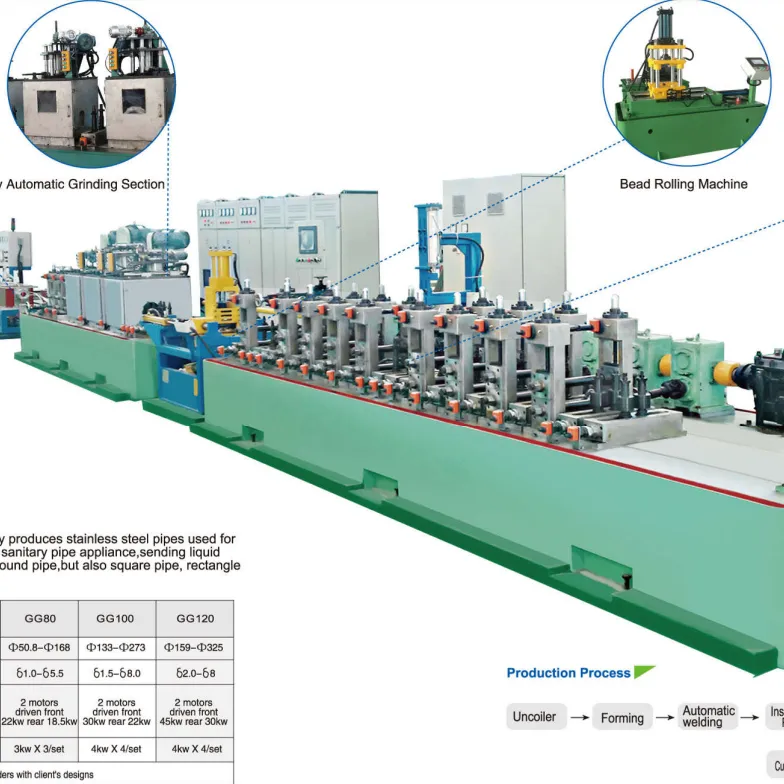
Detailed Manufacturing Process Flow of a Steel Tube Mill
The production of steel tubes involves a meticulously engineered process flow, transforming flat steel strip into precision tubular products. Each stage requires specialized equipment and rigorous quality control to ensure the final product meets exacting specifications.
Process Steps:
Raw steel coils (e.g., carbon steel, 304/316L stainless steel) are loaded onto an uncoiler. The strip is then leveled to remove curvature and internal stresses, ensuring a flat and consistent feed.
The ends of consecutive coils are precisely sheared and then welded together (typically TIG or butt welding) to create a continuous strip for uninterrupted operation of the steel tube mill.
A strip accumulator stores a buffer of material, allowing the mill to run continuously at a constant speed while new coils are being loaded and welded at the front end.
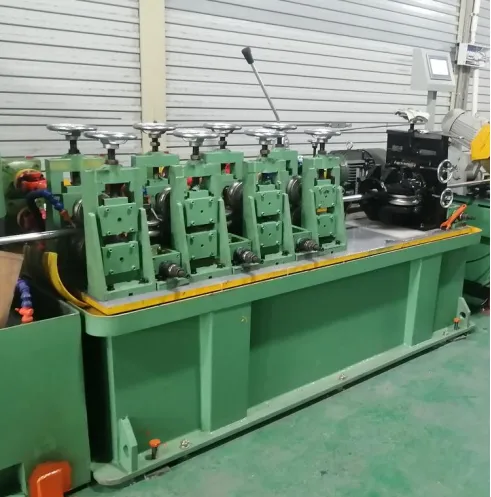
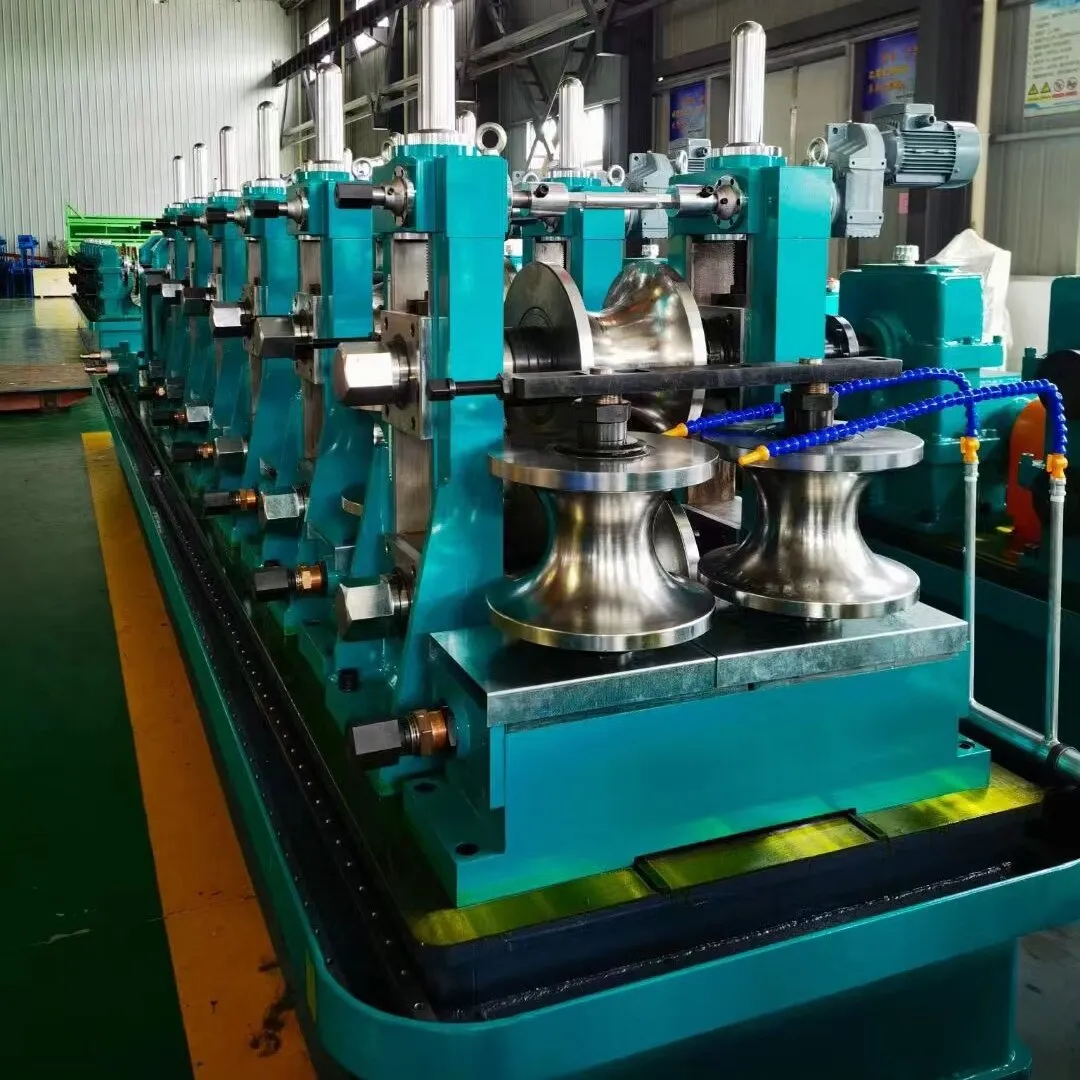
The flat strip progressively passes through a series of forming rollers, gradually shaping it into an open-seam tube. Precision CNC machining of rollers ensures accurate profile generation.
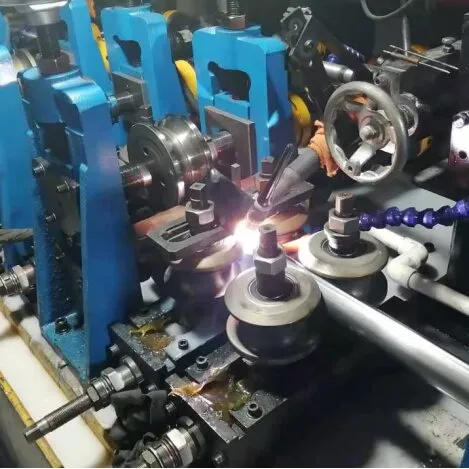
The formed strip edges are joined using advanced welding techniques such as High-Frequency Induction (HFI) welding for carbon steel, or TIG/Laser welding for ss tube mill applications, creating a robust, high-integrity weld seam.
Immediately after welding, the excess external weld bead (flash) is removed by a cutting tool (scarfing tool) to ensure a smooth outer surface.
The welded tube passes through sizing rollers to achieve the final precise outer diameter and wall thickness. Subsequent straightening ensures the tube meets required linearity specifications.
A non-stop flying cut-off saw precisely cuts the continuous tube into predetermined lengths without stopping the production line.
Finishing operations may include deburring, annealing (especially for stainless steel to restore corrosion resistance), polishing, and hydrostatic testing. Online Non-Destructive Testing (NDT) such as Eddy Current or Ultrasonic testing verifies weld integrity and material soundness. All products are tested to standards like ISO 9001, ASTM A554, API 5L, or ANSI B36.19.
The service life of a well-maintained steel tube mill is typically 15-25 years, with critical components designed for easy replacement and upgrades. Target industries include petrochemical, metallurgy, power generation, water supply & drainage, automotive, and construction, where reliability and precision are paramount. Advantages manifest as significant energy saving due to optimized drive systems and enhanced corrosion resistance inherent in stainless steel tubes produced on specialized stainless steel tube mills.
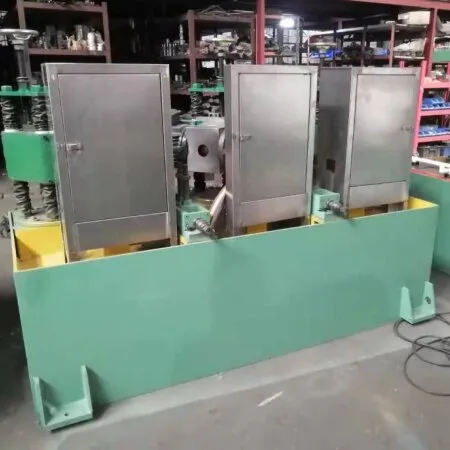
Technical Specifications: YW-40 Stainless Steel Tube Mill
The YW-40 Stainless Steel Tube Mill represents a pinnacle of engineering for precision tube manufacturing. Designed for high-speed production and exceptional material compatibility, it ensures superior weld quality and dimensional accuracy, aligning with stringent industry demands for products such as those used in heat exchangers, automotive exhaust systems, and decorative applications.
| Parameter | Specification (YW-40) |
|---|---|
| Tube Outer Diameter Range (OD) | Ø12.7 mm - Ø40 mm |
| Wall Thickness Range | 0.3 mm - 1.5 mm |
| Strip Width | 38 mm - 126 mm |
| Material Types | Stainless Steel (201, 304, 316L, 430, Duplex), Carbon Steel |
| Welding Speed (Max.) | 80 m/min |
| Main Motor Power | 11 kW AC Variable Frequency Drive |
| Forming Rollers Material | SKD11 / Cr12MoV (Heat Treated HRC58-62) |
| Cutting Method | Automatic Flying Saw (Cold Saw optional) |
| Installed Power | ~75 kW (excluding welding power) |
| Machine Dimensions (Approx.) | 18000 x 1200 x 1600 mm (L x W x H) |
These specifications underscore the YW-40's capability to deliver high-quality, precise tubes consistently. The use of robust, heat-treated materials for rollers ensures longevity and dimensional stability even under continuous, high-stress operation. This specific stainless steel tube mills model is engineered to provide an optimal balance of speed, accuracy, and operational efficiency for high-demand production environments.
Application Scenarios and Technical Advantages
The versatility and high performance of modern steel tube mill systems, particularly those designed for stainless steel, enable their use across a vast array of critical applications. Their technical advantages translate directly into operational benefits for end-users.
Typical Application Scenarios:
- Petrochemical and Oil & Gas: For conveying corrosive fluids and gases, requiring high-pressure resistance and superior corrosion properties (e.g., 316L stainless steel tubing).
- Automotive Industry: Exhaust systems, structural components, and fluid lines where lightweight, high-strength, and corrosion-resistant tubes (e.g., 409L, 304) are essential.
- Food & Beverage Processing: Hygienic tubing for fluid transfer, requiring smooth internal surfaces and non-reactive materials (e.g., polished 304/316L).
- Construction and Architecture: Structural supports, decorative elements, handrails, and plumbing systems benefiting from durability and aesthetic appeal.
- Water Supply & Drainage: Long-lasting, corrosion-free piping solutions that reduce maintenance and replacement costs over decades.
- Heat Exchangers and Boilers: Precision tubes capable of handling high temperatures and pressures, demanding consistent wall thickness and material integrity.
Key Technical Advantages:
- Energy Saving: Incorporating high-efficiency motors (e.g., AC variable frequency drives) and optimized power management systems significantly reduces electricity consumption compared to older models, translating into lower operational costs.
- Superior Corrosion Resistance: Specialized stainless steel tube mills are designed to handle and weld various grades of stainless steel without compromising their inherent corrosion-resistant properties, critical for harsh environments.
- High Dimensional Accuracy: Advanced forming and sizing stages, coupled with robust roller materials and precise CNC machining, ensure tubes are produced with extremely tight tolerances on OD, wall thickness, and straightness.
- Enhanced Weld Integrity: Utilizing high-frequency or laser welding technologies ensures a strong, uniform, and defect-free weld seam, critical for applications involving high pressure or corrosive media.
- Reduced Material Waste: Optimized process control and precision cutting minimize scrap rates, contributing to lower production costs and environmental impact.
Vendor Comparison and Customized Solutions
Choosing the right steel pipe mills vendor is a strategic decision that impacts long-term operational efficiency and product quality. A thorough comparison typically involves evaluating technological prowess, customization capabilities, after-sales support, and proven track record.
Key Factors in Vendor Comparison:
| Criterion | Leading Vendor Attributes | Sub-optimal Vendor Traits |
|---|---|---|
| Technology & Innovation | Advanced automation, energy-efficient designs, precision forming/welding, IoT readiness. | Outdated control systems, high energy consumption, limited material capabilities. |
| Customization & Flexibility | Ability to tailor mill line for specific tube OD/WT ranges, material types, and integration with existing plant infrastructure. | Off-the-shelf solutions only, rigid design, difficulty adapting to unique production needs. |
| After-Sales Support | Comprehensive installation, training, prompt spare parts availability, remote diagnostics, on-site technical assistance. | Slow response times, limited spare parts, inadequate technical expertise for troubleshooting. |
| Certifications & Experience | ISO 9001, CE, extensive project portfolio, years of industry experience, strong client testimonials. | Lack of international certifications, limited project history, unverified performance claims. |
| Cost-Effectiveness (TCO) | Competitive initial cost balanced with low operating costs, high reliability, and long service life. | Initially cheap but high maintenance, frequent breakdowns, and high energy consumption leading to high TCO. |
Customized Solutions for Optimal Performance:
A truly valuable vendor provides more than just machinery; they offer tailored engineering solutions. For a steel tube mill, customization can involve:
- Specific Material Handling: Engineering systems for unusual coil widths, thicknesses, or exotic alloys.
- Unique Tube Profiles: Beyond standard round or square, accommodating oval, rectangular, or complex multi-profile requirements.
- Integrated Downstream Equipment: Seamless integration with polishing lines, annealing furnaces, specialized testing equipment, or automated packaging solutions.
- Environmental Adaptations: Designing mills to operate optimally in challenging environments, such as high humidity or extreme temperatures.
- Production Capacity Scaling: Modular designs that allow for future expansion of speed or size ranges without complete replacement.
Application Case Studies & Client Success
Real-world application demonstrates the tangible benefits and reliability of advanced steel pipe mills. Our experience, cultivated over 20 years in the industry, has enabled us to partner with diverse global manufacturers, delivering tailored solutions that exceed expectations.
Case Study 1: High-Precision Tubing for Medical Devices
A leading manufacturer of medical instruments required ultra-precise, thin-walled stainless steel tubing (OD 6mm, WT 0.2mm) with flawless surface finish and weld integrity for surgical tools. Traditional mills struggled with such delicate specifications. We deployed a customized YW-series ss tube mill equipped with laser welding technology and specialized polishing and sizing units. The result was a consistent output of tubes meeting ISO 13485 standards, achieving a surface roughness average (Ra) of less than 0.4µm, and reducing material waste by 18%. Customer feedback highlighted the mill’s stability and the exceptional training provided to their operators.
Case Study 2: High-Volume Production for Automotive Exhausts
An automotive Tier 1 supplier needed to increase its production capacity for high-volume stainless steel exhaust tubing (OD 30-76mm, WT 1.0-1.5mm) while maintaining strict quality control (e.g., ASTM A554). We supplied a high-speed steel tubing mills line featuring advanced HFI welding and an integrated online Eddy Current NDT system. The mill achieved a sustained production speed of 60 m/min, a 25% increase over their previous setup, with less than 0.1% defect rate. The client lauded the mill's robust construction and the seamless integration into their existing manufacturing ecosystem.
Authoritative Endorsements and Quality Assurance:
Our commitment to quality is underpinned by comprehensive certifications and a robust quality management system. All manufacturing processes adhere to ISO 9001:2015 standards, ensuring consistent quality from design to delivery. Products are routinely tested against international benchmarks such as ASTM, JIS, and DIN. Our machines are CE certified, attesting to their compliance with European safety, health, and environmental protection requirements. We proudly serve a global clientele, including major players in the petrochemical, automotive, and construction industries, reinforcing our position as an authoritative provider of stainless steel tube mills.
Trustworthiness: FAQ, Lead Time, Warranty, and Support
Building trust with our clients is paramount. We achieve this through transparent processes, clear commitments, and robust support infrastructure.
Frequently Asked Questions (FAQ):
- Q: What types of materials can your steel tube mill process?
A: Our mills are designed to process a wide range of materials including various grades of stainless steel (200, 300, 400 series, Duplex), carbon steel, and certain high-alloy steels, subject to specific mill configurations. - Q: What is the typical lead time for a custom stainless steel tube mills?
A: Standard models typically require 60-90 days for manufacturing and testing. Custom configurations or extensive line integrations may extend this to 120-180 days, depending on complexity. - Q: Can your mills be integrated with existing production lines?
A: Yes, our engineering team specializes in designing seamless integrations with existing uncoilers, annealing furnaces, or finishing equipment to optimize your current setup. - Q: What level of automation can be expected?
A: Our mills feature advanced PLC control systems, HMI interfaces for intuitive operation, and options for full automation including automatic coil loading, welding, cutting, and online inspection.
Lead Time and Fulfillment:
Our lead times are carefully managed and communicated throughout the project lifecycle. Upon order confirmation, a detailed project timeline is provided, outlining key milestones from design approval to manufacturing, testing, and shipping. We maintain a robust supply chain for critical components, minimizing potential delays. Factory Acceptance Testing (FAT) is conducted with client participation to ensure all performance parameters are met before shipment.
Warranty Commitments:
We provide a standard 12-month warranty on all mechanical and electrical components from the date of final commissioning or 18 months from shipment, whichever comes first. This warranty covers manufacturing defects and component failures under normal operating conditions. Extended warranty options and service contracts are available for enhanced peace of mind, demonstrating our confidence in the longevity and reliability of our steel tube mill solutions.
Customer Support and After-Sales Service:
Our dedication to customer success extends far beyond machine delivery. We offer comprehensive after-sales support including: remote troubleshooting via secure network connections, on-site technical assistance by experienced engineers, proactive maintenance programs, and a readily available inventory of spare parts. Training programs for client personnel on operation, maintenance, and basic troubleshooting are integral to every project, ensuring optimal performance and maximizing the lifespan of the equipment.
Conclusion
The modern steel tube mill is a cornerstone of industrial manufacturing, continuously evolving to meet the demands for higher precision, efficiency, and material versatility. Our commitment to advanced engineering, rigorous quality standards, and comprehensive customer support ensures that our clients receive not just machinery, but complete solutions designed for long-term operational success. By integrating cutting-edge technology with deep industry expertise, we empower manufacturers to achieve their production goals and maintain a competitive edge in a dynamic global market.
References
- American Society for Testing and Materials (ASTM). ASTM A554: Standard Specification for Welded Stainless Steel Mechanical Tubing. 2023.
- International Organization for Standardization (ISO). ISO 9001:2015: Quality management systems — Requirements. 2015.
- API (American Petroleum Institute). API Specification 5L: Specification for Line Pipe. 46th Ed. 2018.
- Kuhn, B. "Advances in High-Frequency Induction Welding for Steel Tube Production." Journal of Manufacturing Technology, vol. 42, no. 3, 2021, pp. 210-225.
- Sato, H. "Energy Efficiency Optimization in Modern Tube Mills." International Journal of Steel Research, vol. 90, no. 7, 2019, pp. 650-662.